
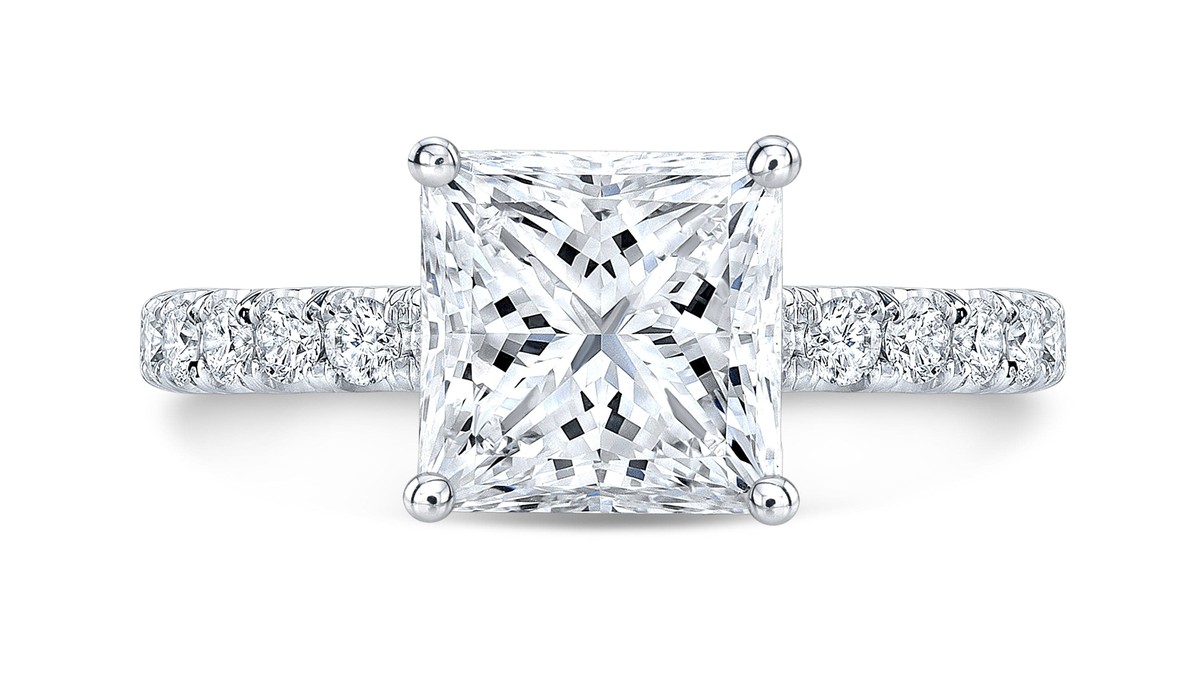
Princess Cut Engagement Rings
POSTED by: Doug on 06/02/2013 — Updated: October 10, 2013
Renowned for its stunning brilliance and sparkle, the Princess Cut is a popular choice for diamond engagement rings, wedding rings and other fine jewelry.
Ritani Split Shank Princess Cut Engagement Ring – by Whiteflash. Setting: $1660 more…
Hand View of Ritani Split Shank Princess Cut Engagement Ring – by Whiteflash. Setting: $1660 more…
A comparatively new type of diamond cut, first created in the 1960s, the Princess cut is often compared with the popular round brilliant. While the round brilliant has a circular face creating a “cone-shaped” form, the Princess cut has a square or rectangular face, with an inverted-pyramid shape that most closely follows the natural crystalline structure of the rough diamond.
Symbolically, the Princess cut is identified with independence, boldness, and confidence. For those desiring the modern lines of a square cut diamond with the brilliance and sparkle of a round cut, the Princess Cut diamond is a choice you will treasure for a lifetime!
Princess Cut Settings
The Princess Cut and Round Cut are the two most popular diamond shapes. They look perfect in a large assortment of stylish ring settings. There’s solitaire, pave, halo, channel and side stone, to name a few.
As a general rule, the Princess cut diamond will be installed in a setting that protects the four corners of the diamond, such as the popular 4-prong setting.
Vatche Petite Pave Princess Cut Engagement Ring – by Whiteflash. Setting: $1836 more…
Verragio Four Prong Princess Cut Solitaire Engagement Ring – by Whiteflash. Setting: $1850 more…
Diamond Solitaire
The solitaire setting is the most well-known: It is a diamond held above the surface of the ring by metal prongs. The number of prongs usually varies from 4 to 6, but the principle is the same: One impressive, breathtaking diamond is featured prominently, with nothing else to draw attention away from it. It’s the most classic type of setting, but one that says so much without saying a word at all.
2mm Knife Edge Solitaire Ring – by James Allen. Setting: $180 more…
Comfort Fit Solitaire Engagement Ring – by James Allen. Setting: $345 more…
2.5mm Knife Edge Solitaire Diamond Ring – by James Allen. Setting: $500 more…
Cross Prong Solitaire Diamond Engagement Ring – by James Allen. Setting: $1525 more…
Princess Cut Four Prong Solitaire – by Brian Gavin Diamonds. Setting: $950 more…
Princess Cut Cathedral Solitaire – by Brian Gavin Diamonds. Setting: $895 more…
Vatche Four Prong Princess Cut Solitaire Engagement Ring – by Whiteflash. Setting: $1340 more…
Tapered Diamond Solitaire Engagement Ring – by James Allen. Setting: $385 more…
Four Prong Princess Cut Solitaire Engagement Ring – by Whiteflash. Setting: $1282 more…
Royal Princess Cut Solitaire Engagement Ring – by Whiteflash. Setting: $1852 more…
The Pave Setting
The pave setting (pronounced “pah-vay”) is similar to the solitaire setting, in that it features one stone held up in the center of the ring. However, while the solitaire style has a simple metal band, the band of a pave setting is “paved” with a river of smaller diamonds.
Pave Cathedral with Claw Prong Basket – by James Allen. Setting: $1300 more…
Thin French-Cut Pave Set Diamond Engagement Ring – by James Allen. Setting: $575 more…
These smaller diamonds are placed on the surface of the ring, with as little metal visible between them as possible, to give the illusion that the wearer has a ring made of diamonds. The smaller stones can line the top of the ring, or even extend all the way around it. The purpose of the pave style is to compliment the center stones, and add more sparkle and brilliance to the ring overall.
Thin Shank Micro Pave – by Brian Gavin Diamonds. Setting: $1670 more…
Engraved Cathedral Engagement Ring – by Brian Gavin Diamonds. Setting: $1540 more…
Vatche Pave Princess Cut Diamond Engagement Ring – by Whiteflash. Setting: $1675 more…
Princess Cut Petite Pave – by Brian Gavin Diamonds. Setting: $1270 more…
Sleek Line Pave Diamond Engagement Ring – by Whiteflash. Setting: $1295 more…
Infinity Pave Engagement Ring – by Whiteflash. Setting: $1495 more…
Halo Settings
The Halo is another very popular setting style. Like the pave, the center diamond is complemented with a number of smaller diamonds. However, with the Halo design the smaller diamonds encircle the larger center stone.
One nice feature of the Halo design is that the ring of smaller diamonds makes the center diamond appear larger as well as adding extra sparkle to the ring.
Fancy Shape Halo Engagement Ring – by Brian Gavin Diamonds. Setting: $2700 more…
Princess Cut Halo Engagement Ring – by James Allen. Setting: $1300 more…
The Channel Setting
Similar to the pave setting, the channel features an array of smaller diamonds along the surface of the band. However, with the channel setting the small diamonds are are held in place by two strips (“channels”) of metal.
Princess Cut Channel Set Engagement Ring – by Brian Gavin Diamonds. Setting: $2590 more…
Channel Set Princess Cut Diamond Engagement Ring – by James Allen. Setting: $1625 more…
Side Stone Settings
The classic side stone setting has a large center diamond complimented by two, or more, smaller stones on either side. One of the most popular types of side stone settings is the “three stone”. It is commonly held that the diamonds in a three stone setting represents the past, present, and future.
The side stones do not have to be diamonds but can be sapphires, rubies or other gemstones.
Princess Trellis 3 Stone Engagement Ring – by Brian Gavin Diamonds. Setting: $1375 more…
Princess Dinah Petite 3 Stone – by Brian Gavin Diamonds. Setting: $2120 more…
Scattered Princess Cut Martini – by Brian Gavin Diamonds. Setting: $1300 more…
Three Stone Channel Princess Cut – by Brian Gavin Diamonds. Setting: $3350 more…
Vintage Settings
Today’s Vintage settings have design patterns influenced by the styling of the Victorian, Edwardian, Art Nouveau and Art Deco periods. Beading, milgrain, filigree and engravings techniques combine to create a look that Is a mixture of these period styles.
Antique Bezel & Pave Set Engagement Ring – by James Allen. Setting: $900 more…
Vintage Engraved Channel Set Engagement Ring – by James Allen. Setting: $1625 more…
Which setting style should you choose? The solitaire, pave and halo setting are very popular for diamond engagement rings. The solitaire is classic and elegant, while the pave and halo are more modern and sparkly designs.
By itself, a pave or halo setting is often higher in price compared with the solitaire setting; however the overall price of a pave/halo engagement ring may turn out to be below that of a solitaire because the center diamond of the pave/halo ring may be made smaller without compromising on the total sparkle and brilliance of the engagement ring.
Please visit our Diamond Engagement Rings page for more information.
The Princess Cut Diamond and The Four C’s
When purchasing a Princess Cut Diamond there are a number of factors to consider, in particular, a knowledge of the Four C’s and how they differ for a Princess Cut.
Most articles about the “Four C’s” (Cut, Color, Clarity, Carat) concentrate on the Round Cut and although the Princess Cut and the Round Cut are both “brilliant” cuts, there are some important differences that should be kept in mind when shopping for a Princess Cut diamond.
Shape
The Princess Cut is usually referred to as a “square modified brilliant” on lab reports and grading certificates.
Like all diamonds, the Princess Cut diamond is initially cut from rough stone. However, the Princess cut’s pyramid-like shape follows the natural crystalline structure of the diamond more effectively than most other shapes and fits closely into one-half of the rough stone. In the cutting process, the Princess shape allows the diamond cutter to produce two equal sized princess cut diamonds from one stone. The Princess Cut retains from 60 percent to 80 percent of the initial weight of the rough diamond compared to only 50% for the Round Cut.
Because the Princess cut retains much more of the original diamond, you will typically get a larger carat sized diamond for the same price when compared with the round brilliant.
Traditionally, the Princess Cut is a square shape with all four sides having an equal length. As the princess cut moves away from the square and towards a rectangle shape, the price will decrease. For reference, once the ratio of length to width is less than 1.05, the princess cut will appear square to the unaided eye.
Cut
A high-quality cut is the ideal choice, and helps to bring out the diamond’s allure, brilliance and sparkle. The brilliance of the stone can be altered a great deal with just one downgrade.
Unlike the Round Cut, there currently is no industry-wide consensus on what parameters make up the perfect Princess Cut. The American Gem Society now offers a scientific cut grade based on actual light performance; however the GIA will only grade Polish and Symmetry on a Princess Cut diamond.
However, due to customer demand, each diamond seller will have their own Cut grading system for princess cut diamonds. In addition, the proportions below can be helpful when judging the cut of a princess cut diamond.
- Polish – excellent to good
- Height of the crown – 8 to 13%
- Depth total – 62 to 73%
- Length to width ratio – 1.0 to 1.05
- Table size – 65 to 75%
Best Value: As with round diamonds, don’t skimp on cut, it’s where the sparkle is! Look for Excellent/Ideal cuts.
Color
The Princess cut retains the color of the original stone better as compared to other cuts. Which means that the Color grade is somewhat more important for the Princess Cut than the Round Cut. It is best to select colors lower than J. The J-color may tend to show some yellowish tint in the corners of a princess cut diamond.
Best Value: Select a Color grade of G, H or I.
Clarity
Because of its brilliance, the Princess Cut is more forgiving of inclusions than other square cuts.
However, as impurities in the princess cut diamond can weaken the strength of the stone, special attention should be paid to the corners of the stone and any inclusions therein. Problems can eventually occur with cracking and chipping when impurities are located at the stone’s corners.
Best Value: For Princess Cuts, select a grade of VS2 or SI1 or better.
Carats
As stated above, for the same price a larger carat Princess Cut Diamond can be purchased versus a Round Cut Diamond. However, the Princess shape has a larger depth percentage than the Round cut which means that for stones of the same carat weight the Princess Cut’s surface area may appear smaller than the Round Cut.
Best Value: There is a price break at 1.0 ct, so look for diamonds just under 1 ct.
Over the decades since its creation, the princess cut has gained in popularity, especially as an engagement ring. While it still is considered a modern innovation in diamond design, the rising popularity of this timeless look has set a new tradition in jewelry. Already, the sparkle of this design has captured the hearts of many customers seeking a stylish yet classic look for a diamond engagement ring.
The princess cut is considered one of the most fashionable and desirable cuts. Its larger carat size for the same price, along with its attractive shape and brilliant sparkle, makes the Princess one of the most popular choices for a diamond engagement ring.

About Doug
Blogging about Engagement Rings, Diamonds, Wedding Rings and other Fine Jewelry. Follow me on Pinterest
Please Leave a Comment!
We’d love to hear your thoughts!